Notice Na Dnote Momets Again and Again

Working with missing data

In this section, we will discuss missing (also referred to as NA) values in pandas.

Note

The choice of using NaN internally to denote missing data was largely for simplicity and performance reasons. Starting from pandas 1.0, some optional data types start experimenting with a native NA scalar using a mask-based approach. See here for more.

See the cookbook for some advanced strategies.

Values considered "missing"

As data comes in many shapes and forms, pandas aims to be flexible with regard to handling missing data. While NaN is the default missing value marker for reasons of computational speed and convenience, we need to be able to easily detect this value with data of different types: floating point, integer, boolean, and general object. In many cases, however, the Python None will arise and we wish to also consider that "missing" or "not available" or "NA".

Note

If you want to consider inf and -inf to be "NA" in computations, you can set pandas.options.mode.use_inf_as_na = True .

                            In [1]:                            df              =              pd              .              DataFrame              (                              ...:                            np              .              random              .              randn              (              5              ,              3              ),                              ...:                            index              =              [              "a"              ,              "c"              ,              "e"              ,              "f"              ,              "h"              ],                              ...:                            columns              =              [              "one"              ,              "two"              ,              "three"              ],                              ...:                            )                              ...:                            In [2]:                            df              [              "four"              ]              =              "bar"              In [3]:                            df              [              "five"              ]              =              df              [              "one"              ]              >              0              In [4]:                            df              Out[4]:                                                          one       two     three four   five              a  0.469112 -0.282863 -1.509059  bar   True              c -1.135632  1.212112 -0.173215  bar  False              e  0.119209 -1.044236 -0.861849  bar   True              f -2.104569 -0.494929  1.071804  bar  False              h  0.721555 -0.706771 -1.039575  bar   True              In [5]:                            df2              =              df              .              reindex              ([              "a"              ,              "b"              ,              "c"              ,              "d"              ,              "e"              ,              "f"              ,              "g"              ,              "h"              ])              In [6]:                            df2              Out[6]:                                                          one       two     three four   five              a  0.469112 -0.282863 -1.509059  bar   True              b       NaN       NaN       NaN  NaN    NaN              c -1.135632  1.212112 -0.173215  bar  False              d       NaN       NaN       NaN  NaN    NaN              e  0.119209 -1.044236 -0.861849  bar   True              f -2.104569 -0.494929  1.071804  bar  False              g       NaN       NaN       NaN  NaN    NaN              h  0.721555 -0.706771 -1.039575  bar   True            

To make detecting missing values easier (and across different array dtypes), pandas provides the isna() and notna() functions, which are also methods on Series and DataFrame objects:

                            In [7]:                            df2              [              "one"              ]              Out[7]:                                          a    0.469112              b         NaN              c   -1.135632              d         NaN              e    0.119209              f   -2.104569              g         NaN              h    0.721555              Name: one, dtype: float64              In [8]:                            pd              .              isna              (              df2              [              "one"              ])              Out[8]:                                          a    False              b     True              c    False              d     True              e    False              f    False              g     True              h    False              Name: one, dtype: bool              In [9]:                            df2              [              "four"              ]              .              notna              ()              Out[9]:                                          a     True              b    False              c     True              d    False              e     True              f     True              g    False              h     True              Name: four, dtype: bool              In [10]:                            df2              .              isna              ()              Out[10]:                                                          one    two  three   four   five              a  False  False  False  False  False              b   True   True   True   True   True              c  False  False  False  False  False              d   True   True   True   True   True              e  False  False  False  False  False              f  False  False  False  False  False              g   True   True   True   True   True              h  False  False  False  False  False            

Warning

One has to be mindful that in Python (and NumPy), the nan's don't compare equal, but None's do. Note that pandas/NumPy uses the fact that np.nan != np.nan , and treats None like np.nan .

                                In [11]:                                None                ==                None                # noqa: E711                Out[11]:                                True                In [12]:                                np                .                nan                ==                np                .                nan                Out[12]:                                False              

So as compared to above, a scalar equality comparison versus a None/np.nan doesn't provide useful information.

                                In [13]:                                df2                [                "one"                ]                ==                np                .                nan                Out[13]:                                                a    False                b    False                c    False                d    False                e    False                f    False                g    False                h    False                Name: one, dtype: bool              

Integer dtypes and missing data

Because NaN is a float, a column of integers with even one missing values is cast to floating-point dtype (see Support for integer NA for more). pandas provides a nullable integer array, which can be used by explicitly requesting the dtype:

                                In [14]:                                pd                .                Series                ([                1                ,                2                ,                np                .                nan                ,                4                ],                dtype                =                pd                .                Int64Dtype                ())                Out[14]:                                                0       1                1       2                2    <NA>                3       4                dtype: Int64              

Alternatively, the string alias dtype='Int64' (note the capital "I" ) can be used.

See Nullable integer data type for more.

Datetimes

For datetime64[ns] types, NaT represents missing values. This is a pseudo-native sentinel value that can be represented by NumPy in a singular dtype (datetime64[ns]). pandas objects provide compatibility between NaT and NaN .

                                In [15]:                                df2                =                df                .                copy                ()                In [16]:                                df2                [                "timestamp"                ]                =                pd                .                Timestamp                (                "20120101"                )                In [17]:                                df2                Out[17]:                                                                  one       two     three four   five  timestamp                a  0.469112 -0.282863 -1.509059  bar   True 2012-01-01                c -1.135632  1.212112 -0.173215  bar  False 2012-01-01                e  0.119209 -1.044236 -0.861849  bar   True 2012-01-01                f -2.104569 -0.494929  1.071804  bar  False 2012-01-01                h  0.721555 -0.706771 -1.039575  bar   True 2012-01-01                In [18]:                                df2                .                loc                [[                "a"                ,                "c"                ,                "h"                ],                [                "one"                ,                "timestamp"                ]]                =                np                .                nan                In [19]:                                df2                Out[19]:                                                                  one       two     three four   five  timestamp                a       NaN -0.282863 -1.509059  bar   True        NaT                c       NaN  1.212112 -0.173215  bar  False        NaT                e  0.119209 -1.044236 -0.861849  bar   True 2012-01-01                f -2.104569 -0.494929  1.071804  bar  False 2012-01-01                h       NaN -0.706771 -1.039575  bar   True        NaT                In [20]:                                df2                .                dtypes                .                value_counts                ()                Out[20]:                                                float64           3                object            1                bool              1                datetime64[ns]    1                dtype: int64              

Inserting missing data

You can insert missing values by simply assigning to containers. The actual missing value used will be chosen based on the dtype.

For example, numeric containers will always use NaN regardless of the missing value type chosen:

                            In [21]:                            s              =              pd              .              Series              ([              1              ,              2              ,              3              ])              In [22]:                            s              .              loc              [              0              ]              =              None              In [23]:                            s              Out[23]:                                          0    NaN              1    2.0              2    3.0              dtype: float64            

Likewise, datetime containers will always use NaT .

For object containers, pandas will use the value given:

                            In [24]:                            s              =              pd              .              Series              ([              "a"              ,              "b"              ,              "c"              ])              In [25]:                            s              .              loc              [              0              ]              =              None              In [26]:                            s              .              loc              [              1              ]              =              np              .              nan              In [27]:                            s              Out[27]:                                          0    None              1     NaN              2       c              dtype: object            

Calculations with missing data

Missing values propagate naturally through arithmetic operations between pandas objects.

                            In [28]:                            a              Out[28]:                                                          one       two              a       NaN -0.282863              c       NaN  1.212112              e  0.119209 -1.044236              f -2.104569 -0.494929              h -2.104569 -0.706771              In [29]:                            b              Out[29]:                                                          one       two     three              a       NaN -0.282863 -1.509059              c       NaN  1.212112 -0.173215              e  0.119209 -1.044236 -0.861849              f -2.104569 -0.494929  1.071804              h       NaN -0.706771 -1.039575              In [30]:                            a              +              b              Out[30]:                                                          one  three       two              a       NaN    NaN -0.565727              c       NaN    NaN  2.424224              e  0.238417    NaN -2.088472              f -4.209138    NaN -0.989859              h       NaN    NaN -1.413542            

The descriptive statistics and computational methods discussed in the data structure overview (and listed here and here) are all written to account for missing data. For example:

  • When summing data, NA (missing) values will be treated as zero.

  • If the data are all NA, the result will be 0.

  • Cumulative methods like cumsum() and cumprod() ignore NA values by default, but preserve them in the resulting arrays. To override this behaviour and include NA values, use skipna=False .

                            In [31]:                            df              Out[31]:                                                          one       two     three              a       NaN -0.282863 -1.509059              c       NaN  1.212112 -0.173215              e  0.119209 -1.044236 -0.861849              f -2.104569 -0.494929  1.071804              h       NaN -0.706771 -1.039575              In [32]:                            df              [              "one"              ]              .              sum              ()              Out[32]:                            -1.9853605075978744              In [33]:                            df              .              mean              (              1              )              Out[33]:                                          a   -0.895961              c    0.519449              e   -0.595625              f   -0.509232              h   -0.873173              dtype: float64              In [34]:                            df              .              cumsum              ()              Out[34]:                                                          one       two     three              a       NaN -0.282863 -1.509059              c       NaN  0.929249 -1.682273              e  0.119209 -0.114987 -2.544122              f -1.985361 -0.609917 -1.472318              h       NaN -1.316688 -2.511893              In [35]:                            df              .              cumsum              (              skipna              =              False              )              Out[35]:                                                          one       two     three              a  NaN -0.282863 -1.509059              c  NaN  0.929249 -1.682273              e  NaN -0.114987 -2.544122              f  NaN -0.609917 -1.472318              h  NaN -1.316688 -2.511893            

Sum/prod of empties/nans

Warning

This behavior is now standard as of v0.22.0 and is consistent with the default in numpy ; previously sum/prod of all-NA or empty Series/DataFrames would return NaN. See v0.22.0 whatsnew for more.

The sum of an empty or all-NA Series or column of a DataFrame is 0.

                            In [36]:                            pd              .              Series              ([              np              .              nan              ])              .              sum              ()              Out[36]:                            0.0              In [37]:                            pd              .              Series              ([],              dtype              =              "float64"              )              .              sum              ()              Out[37]:                            0.0            

The product of an empty or all-NA Series or column of a DataFrame is 1.

                            In [38]:                            pd              .              Series              ([              np              .              nan              ])              .              prod              ()              Out[38]:                            1.0              In [39]:                            pd              .              Series              ([],              dtype              =              "float64"              )              .              prod              ()              Out[39]:                            1.0            

NA values in GroupBy

NA groups in GroupBy are automatically excluded. This behavior is consistent with R, for example:

                            In [40]:                            df              Out[40]:                                                          one       two     three              a       NaN -0.282863 -1.509059              c       NaN  1.212112 -0.173215              e  0.119209 -1.044236 -0.861849              f -2.104569 -0.494929  1.071804              h       NaN -0.706771 -1.039575              In [41]:                            df              .              groupby              (              "one"              )              .              mean              ()              Out[41]:                                                          two     three              one                            -2.104569 -0.494929  1.071804                              0.119209 -1.044236 -0.861849            

See the groupby section here for more information.

Cleaning / filling missing data

pandas objects are equipped with various data manipulation methods for dealing with missing data.

Filling missing values: fillna

fillna() can "fill in" NA values with non-NA data in a couple of ways, which we illustrate:

Replace NA with a scalar value

                            In [42]:                            df2              Out[42]:                                                          one       two     three four   five  timestamp              a       NaN -0.282863 -1.509059  bar   True        NaT              c       NaN  1.212112 -0.173215  bar  False        NaT              e  0.119209 -1.044236 -0.861849  bar   True 2012-01-01              f -2.104569 -0.494929  1.071804  bar  False 2012-01-01              h       NaN -0.706771 -1.039575  bar   True        NaT              In [43]:                            df2              .              fillna              (              0              )              Out[43]:                                                          one       two     three four   five            timestamp              a  0.000000 -0.282863 -1.509059  bar   True                    0              c  0.000000  1.212112 -0.173215  bar  False                    0              e  0.119209 -1.044236 -0.861849  bar   True  2012-01-01 00:00:00              f -2.104569 -0.494929  1.071804  bar  False  2012-01-01 00:00:00              h  0.000000 -0.706771 -1.039575  bar   True                    0              In [44]:                            df2              [              "one"              ]              .              fillna              (              "missing"              )              Out[44]:                                          a     missing              c     missing              e    0.119209              f   -2.104569              h     missing              Name: one, dtype: object            

Fill gaps forward or backward

Using the same filling arguments as reindexing, we can propagate non-NA values forward or backward:

                            In [45]:                            df              Out[45]:                                                          one       two     three              a       NaN -0.282863 -1.509059              c       NaN  1.212112 -0.173215              e  0.119209 -1.044236 -0.861849              f -2.104569 -0.494929  1.071804              h       NaN -0.706771 -1.039575              In [46]:                            df              .              fillna              (              method              =              "pad"              )              Out[46]:                                                          one       two     three              a       NaN -0.282863 -1.509059              c       NaN  1.212112 -0.173215              e  0.119209 -1.044236 -0.861849              f -2.104569 -0.494929  1.071804              h -2.104569 -0.706771 -1.039575            

Limit the amount of filling

If we only want consecutive gaps filled up to a certain number of data points, we can use the limit keyword:

                            In [47]:                            df              Out[47]:                                                          one       two     three              a  NaN -0.282863 -1.509059              c  NaN  1.212112 -0.173215              e  NaN       NaN       NaN              f  NaN       NaN       NaN              h  NaN -0.706771 -1.039575              In [48]:                            df              .              fillna              (              method              =              "pad"              ,              limit              =              1              )              Out[48]:                                                          one       two     three              a  NaN -0.282863 -1.509059              c  NaN  1.212112 -0.173215              e  NaN  1.212112 -0.173215              f  NaN       NaN       NaN              h  NaN -0.706771 -1.039575            

To remind you, these are the available filling methods:

Method

Action

pad / ffill

Fill values forward

bfill / backfill

Fill values backward

With time series data, using pad/ffill is extremely common so that the "last known value" is available at every time point.

ffill() is equivalent to fillna(method='ffill') and bfill() is equivalent to fillna(method='bfill')

Filling with a PandasObject

You can also fillna using a dict or Series that is alignable. The labels of the dict or index of the Series must match the columns of the frame you wish to fill. The use case of this is to fill a DataFrame with the mean of that column.

                            In [49]:                            dff              =              pd              .              DataFrame              (              np              .              random              .              randn              (              10              ,              3              ),              columns              =              list              (              "ABC"              ))              In [50]:                            dff              .              iloc              [              3              :              5              ,              0              ]              =              np              .              nan              In [51]:                            dff              .              iloc              [              4              :              6              ,              1              ]              =              np              .              nan              In [52]:                            dff              .              iloc              [              5              :              8              ,              2              ]              =              np              .              nan              In [53]:                            dff              Out[53]:                                                          A         B         C              0  0.271860 -0.424972  0.567020              1  0.276232 -1.087401 -0.673690              2  0.113648 -1.478427  0.524988              3       NaN  0.577046 -1.715002              4       NaN       NaN -1.157892              5 -1.344312       NaN       NaN              6 -0.109050  1.643563       NaN              7  0.357021 -0.674600       NaN              8 -0.968914 -1.294524  0.413738              9  0.276662 -0.472035 -0.013960              In [54]:                            dff              .              fillna              (              dff              .              mean              ())              Out[54]:                                                          A         B         C              0  0.271860 -0.424972  0.567020              1  0.276232 -1.087401 -0.673690              2  0.113648 -1.478427  0.524988              3 -0.140857  0.577046 -1.715002              4 -0.140857 -0.401419 -1.157892              5 -1.344312 -0.401419 -0.293543              6 -0.109050  1.643563 -0.293543              7  0.357021 -0.674600 -0.293543              8 -0.968914 -1.294524  0.413738              9  0.276662 -0.472035 -0.013960              In [55]:                            dff              .              fillna              (              dff              .              mean              ()[              "B"              :              "C"              ])              Out[55]:                                                          A         B         C              0  0.271860 -0.424972  0.567020              1  0.276232 -1.087401 -0.673690              2  0.113648 -1.478427  0.524988              3       NaN  0.577046 -1.715002              4       NaN -0.401419 -1.157892              5 -1.344312 -0.401419 -0.293543              6 -0.109050  1.643563 -0.293543              7  0.357021 -0.674600 -0.293543              8 -0.968914 -1.294524  0.413738              9  0.276662 -0.472035 -0.013960            

Same result as above, but is aligning the 'fill' value which is a Series in this case.

                            In [56]:                            dff              .              where              (              pd              .              notna              (              dff              ),              dff              .              mean              (),              axis              =              "columns"              )              Out[56]:                                                          A         B         C              0  0.271860 -0.424972  0.567020              1  0.276232 -1.087401 -0.673690              2  0.113648 -1.478427  0.524988              3 -0.140857  0.577046 -1.715002              4 -0.140857 -0.401419 -1.157892              5 -1.344312 -0.401419 -0.293543              6 -0.109050  1.643563 -0.293543              7  0.357021 -0.674600 -0.293543              8 -0.968914 -1.294524  0.413738              9  0.276662 -0.472035 -0.013960            

Dropping axis labels with missing data: dropna

You may wish to simply exclude labels from a data set which refer to missing data. To do this, use dropna() :

                            In [57]:                            df              Out[57]:                                                          one       two     three              a  NaN -0.282863 -1.509059              c  NaN  1.212112 -0.173215              e  NaN  0.000000  0.000000              f  NaN  0.000000  0.000000              h  NaN -0.706771 -1.039575              In [58]:                            df              .              dropna              (              axis              =              0              )              Out[58]:                                          Empty DataFrame              Columns: [one, two, three]              Index: []              In [59]:                            df              .              dropna              (              axis              =              1              )              Out[59]:                                                          two     three              a -0.282863 -1.509059              c  1.212112 -0.173215              e  0.000000  0.000000              f  0.000000  0.000000              h -0.706771 -1.039575              In [60]:                            df              [              "one"              ]              .              dropna              ()              Out[60]:                            Series([], Name: one, dtype: float64)            

An equivalent dropna() is available for Series. DataFrame.dropna has considerably more options than Series.dropna, which can be examined in the API.

Interpolation

Both Series and DataFrame objects have interpolate() that, by default, performs linear interpolation at missing data points.

                            In [61]:                            ts              Out[61]:                                          2000-01-31    0.469112              2000-02-29         NaN              2000-03-31         NaN              2000-04-28         NaN              2000-05-31         NaN                              ...                            2007-12-31   -6.950267              2008-01-31   -7.904475              2008-02-29   -6.441779              2008-03-31   -8.184940              2008-04-30   -9.011531              Freq: BM, Length: 100, dtype: float64              In [62]:                            ts              .              count              ()              Out[62]:                            66              In [63]:                            ts              .              plot              ()              Out[63]:                            <AxesSubplot:>            
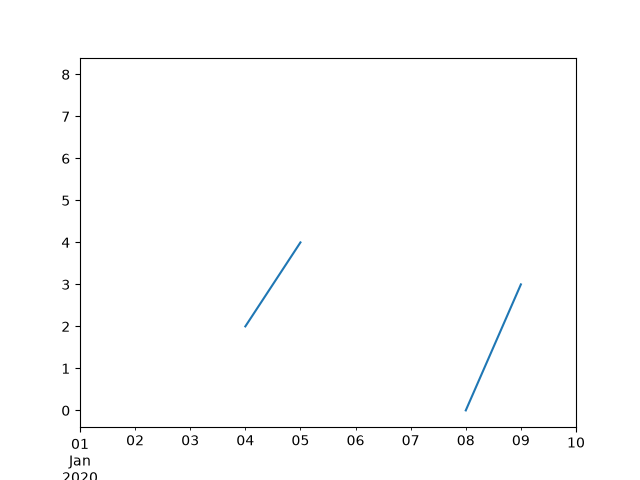
../_images/series_before_interpolate.png
                            In [64]:                            ts              .              interpolate              ()              Out[64]:                                          2000-01-31    0.469112              2000-02-29    0.434469              2000-03-31    0.399826              2000-04-28    0.365184              2000-05-31    0.330541                              ...                            2007-12-31   -6.950267              2008-01-31   -7.904475              2008-02-29   -6.441779              2008-03-31   -8.184940              2008-04-30   -9.011531              Freq: BM, Length: 100, dtype: float64              In [65]:                            ts              .              interpolate              ()              .              count              ()              Out[65]:                            100              In [66]:                            ts              .              interpolate              ()              .              plot              ()              Out[66]:                            <AxesSubplot:>            
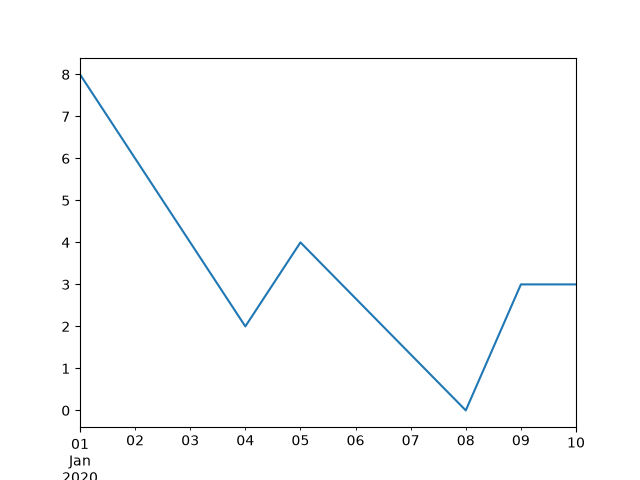
../_images/series_interpolate.png

Index aware interpolation is available via the method keyword:

                            In [67]:                            ts2              Out[67]:                                          2000-01-31    0.469112              2000-02-29         NaN              2002-07-31   -5.785037              2005-01-31         NaN              2008-04-30   -9.011531              dtype: float64              In [68]:                            ts2              .              interpolate              ()              Out[68]:                                          2000-01-31    0.469112              2000-02-29   -2.657962              2002-07-31   -5.785037              2005-01-31   -7.398284              2008-04-30   -9.011531              dtype: float64              In [69]:                            ts2              .              interpolate              (              method              =              "time"              )              Out[69]:                                          2000-01-31    0.469112              2000-02-29    0.270241              2002-07-31   -5.785037              2005-01-31   -7.190866              2008-04-30   -9.011531              dtype: float64            

For a floating-point index, use method='values' :

                            In [70]:                            ser              Out[70]:                                          0.0      0.0              1.0      NaN              10.0    10.0              dtype: float64              In [71]:                            ser              .              interpolate              ()              Out[71]:                                          0.0      0.0              1.0      5.0              10.0    10.0              dtype: float64              In [72]:                            ser              .              interpolate              (              method              =              "values"              )              Out[72]:                                          0.0      0.0              1.0      1.0              10.0    10.0              dtype: float64            

You can also interpolate with a DataFrame:

                            In [73]:                            df              =              pd              .              DataFrame              (                              ....:                            {                              ....:                            "A"              :              [              1              ,              2.1              ,              np              .              nan              ,              4.7              ,              5.6              ,              6.8              ],                              ....:                            "B"              :              [              0.25              ,              np              .              nan              ,              np              .              nan              ,              4              ,              12.2              ,              14.4              ],                              ....:                            }                              ....:                            )                              ....:                            In [74]:                            df              Out[74]:                                                          A      B              0  1.0   0.25              1  2.1    NaN              2  NaN    NaN              3  4.7   4.00              4  5.6  12.20              5  6.8  14.40              In [75]:                            df              .              interpolate              ()              Out[75]:                                                          A      B              0  1.0   0.25              1  2.1   1.50              2  3.4   2.75              3  4.7   4.00              4  5.6  12.20              5  6.8  14.40            

The method argument gives access to fancier interpolation methods. If you have scipy installed, you can pass the name of a 1-d interpolation routine to method . You'll want to consult the full scipy interpolation documentation and reference guide for details. The appropriate interpolation method will depend on the type of data you are working with.

  • If you are dealing with a time series that is growing at an increasing rate, method='quadratic' may be appropriate.

  • If you have values approximating a cumulative distribution function, then method='pchip' should work well.

  • To fill missing values with goal of smooth plotting, consider method='akima' .

Warning

These methods require scipy .

                            In [76]:                            df              .              interpolate              (              method              =              "barycentric"              )              Out[76]:                                                          A       B              0  1.00   0.250              1  2.10  -7.660              2  3.53  -4.515              3  4.70   4.000              4  5.60  12.200              5  6.80  14.400              In [77]:                            df              .              interpolate              (              method              =              "pchip"              )              Out[77]:                                                          A          B              0  1.00000   0.250000              1  2.10000   0.672808              2  3.43454   1.928950              3  4.70000   4.000000              4  5.60000  12.200000              5  6.80000  14.400000              In [78]:                            df              .              interpolate              (              method              =              "akima"              )              Out[78]:                                                          A          B              0  1.000000   0.250000              1  2.100000  -0.873316              2  3.406667   0.320034              3  4.700000   4.000000              4  5.600000  12.200000              5  6.800000  14.400000            

When interpolating via a polynomial or spline approximation, you must also specify the degree or order of the approximation:

                            In [79]:                            df              .              interpolate              (              method              =              "spline"              ,              order              =              2              )              Out[79]:                                                          A          B              0  1.000000   0.250000              1  2.100000  -0.428598              2  3.404545   1.206900              3  4.700000   4.000000              4  5.600000  12.200000              5  6.800000  14.400000              In [80]:                            df              .              interpolate              (              method              =              "polynomial"              ,              order              =              2              )              Out[80]:                                                          A          B              0  1.000000   0.250000              1  2.100000  -2.703846              2  3.451351  -1.453846              3  4.700000   4.000000              4  5.600000  12.200000              5  6.800000  14.400000            

Compare several methods:

                            In [81]:                            np              .              random              .              seed              (              2              )              In [82]:                            ser              =              pd              .              Series              (              np              .              arange              (              1              ,              10.1              ,              0.25              )              **              2              +              np              .              random              .              randn              (              37              ))              In [83]:                            missing              =              np              .              array              ([              4              ,              13              ,              14              ,              15              ,              16              ,              17              ,              18              ,              20              ,              29              ])              In [84]:                            ser              [              missing              ]              =              np              .              nan              In [85]:                            methods              =              [              "linear"              ,              "quadratic"              ,              "cubic"              ]              In [86]:                            df              =              pd              .              DataFrame              ({              m              :              ser              .              interpolate              (              method              =              m              )              for              m              in              methods              })              In [87]:                            df              .              plot              ()              Out[87]:                            <AxesSubplot:>            
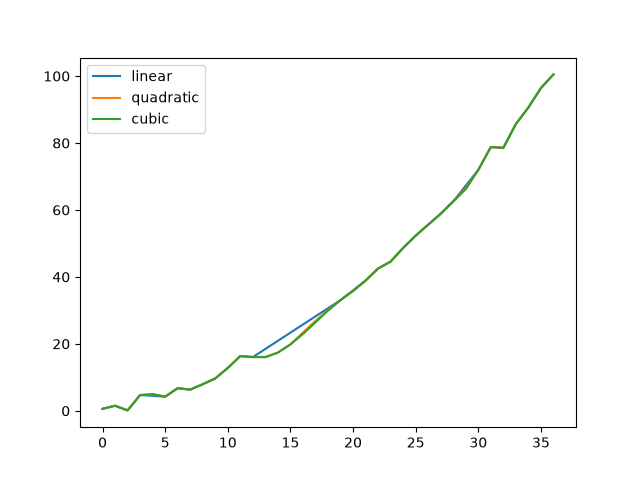
../_images/compare_interpolations.png

Another use case is interpolation at new values. Suppose you have 100 observations from some distribution. And let's suppose that you're particularly interested in what's happening around the middle. You can mix pandas' reindex and interpolate methods to interpolate at the new values.

                            In [88]:                            ser              =              pd              .              Series              (              np              .              sort              (              np              .              random              .              uniform              (              size              =              100              )))              # interpolate at new_index              In [89]:                            new_index              =              ser              .              index              .              union              (              pd              .              Index              ([              49.25              ,              49.5              ,              49.75              ,              50.25              ,              50.5              ,              50.75              ]))              In [90]:                            interp_s              =              ser              .              reindex              (              new_index              )              .              interpolate              (              method              =              "pchip"              )              In [91]:                            interp_s              [              49              :              51              ]              Out[91]:                                          49.00    0.471410              49.25    0.476841              49.50    0.481780              49.75    0.485998              50.00    0.489266              50.25    0.491814              50.50    0.493995              50.75    0.495763              51.00    0.497074              dtype: float64            

Interpolation limits

Like other pandas fill methods, interpolate() accepts a limit keyword argument. Use this argument to limit the number of consecutive NaN values filled since the last valid observation:

                                In [92]:                                ser                =                pd                .                Series                ([                np                .                nan                ,                np                .                nan                ,                5                ,                np                .                nan                ,                np                .                nan                ,                np                .                nan                ,                13                ,                np                .                nan                ,                np                .                nan                ])                In [93]:                                ser                Out[93]:                                                0     NaN                1     NaN                2     5.0                3     NaN                4     NaN                5     NaN                6    13.0                7     NaN                8     NaN                dtype: float64                # fill all consecutive values in a forward direction                In [94]:                                ser                .                interpolate                ()                Out[94]:                                                0     NaN                1     NaN                2     5.0                3     7.0                4     9.0                5    11.0                6    13.0                7    13.0                8    13.0                dtype: float64                # fill one consecutive value in a forward direction                In [95]:                                ser                .                interpolate                (                limit                =                1                )                Out[95]:                                                0     NaN                1     NaN                2     5.0                3     7.0                4     NaN                5     NaN                6    13.0                7    13.0                8     NaN                dtype: float64              

By default, NaN values are filled in a forward direction. Use limit_direction parameter to fill backward or from both directions.

                                # fill one consecutive value backwards                In [96]:                                ser                .                interpolate                (                limit                =                1                ,                limit_direction                =                "backward"                )                Out[96]:                                                0     NaN                1     5.0                2     5.0                3     NaN                4     NaN                5    11.0                6    13.0                7     NaN                8     NaN                dtype: float64                # fill one consecutive value in both directions                In [97]:                                ser                .                interpolate                (                limit                =                1                ,                limit_direction                =                "both"                )                Out[97]:                                                0     NaN                1     5.0                2     5.0                3     7.0                4     NaN                5    11.0                6    13.0                7    13.0                8     NaN                dtype: float64                # fill all consecutive values in both directions                In [98]:                                ser                .                interpolate                (                limit_direction                =                "both"                )                Out[98]:                                                0     5.0                1     5.0                2     5.0                3     7.0                4     9.0                5    11.0                6    13.0                7    13.0                8    13.0                dtype: float64              

By default, NaN values are filled whether they are inside (surrounded by) existing valid values, or outside existing valid values. The limit_area parameter restricts filling to either inside or outside values.

                                # fill one consecutive inside value in both directions                In [99]:                                ser                .                interpolate                (                limit_direction                =                "both"                ,                limit_area                =                "inside"                ,                limit                =                1                )                Out[99]:                                                0     NaN                1     NaN                2     5.0                3     7.0                4     NaN                5    11.0                6    13.0                7     NaN                8     NaN                dtype: float64                # fill all consecutive outside values backward                In [100]:                                ser                .                interpolate                (                limit_direction                =                "backward"                ,                limit_area                =                "outside"                )                Out[100]:                                                0     5.0                1     5.0                2     5.0                3     NaN                4     NaN                5     NaN                6    13.0                7     NaN                8     NaN                dtype: float64                # fill all consecutive outside values in both directions                In [101]:                                ser                .                interpolate                (                limit_direction                =                "both"                ,                limit_area                =                "outside"                )                Out[101]:                                                0     5.0                1     5.0                2     5.0                3     NaN                4     NaN                5     NaN                6    13.0                7    13.0                8    13.0                dtype: float64              

Replacing generic values

Often times we want to replace arbitrary values with other values.

replace() in Series and replace() in DataFrame provides an efficient yet flexible way to perform such replacements.

For a Series, you can replace a single value or a list of values by another value:

                            In [102]:                            ser              =              pd              .              Series              ([              0.0              ,              1.0              ,              2.0              ,              3.0              ,              4.0              ])              In [103]:                            ser              .              replace              (              0              ,              5              )              Out[103]:                                          0    5.0              1    1.0              2    2.0              3    3.0              4    4.0              dtype: float64            

You can replace a list of values by a list of other values:

                            In [104]:                            ser              .              replace              ([              0              ,              1              ,              2              ,              3              ,              4              ],              [              4              ,              3              ,              2              ,              1              ,              0              ])              Out[104]:                                          0    4.0              1    3.0              2    2.0              3    1.0              4    0.0              dtype: float64            

You can also specify a mapping dict:

                            In [105]:                            ser              .              replace              ({              0              :              10              ,              1              :              100              })              Out[105]:                                          0     10.0              1    100.0              2      2.0              3      3.0              4      4.0              dtype: float64            

For a DataFrame, you can specify individual values by column:

                            In [106]:                            df              =              pd              .              DataFrame              ({              "a"              :              [              0              ,              1              ,              2              ,              3              ,              4              ],              "b"              :              [              5              ,              6              ,              7              ,              8              ,              9              ]})              In [107]:                            df              .              replace              ({              "a"              :              0              ,              "b"              :              5              },              100              )              Out[107]:                                                          a    b              0  100  100              1    1    6              2    2    7              3    3    8              4    4    9            

Instead of replacing with specified values, you can treat all given values as missing and interpolate over them:

                            In [108]:                            ser              .              replace              ([              1              ,              2              ,              3              ],              method              =              "pad"              )              Out[108]:                                          0    0.0              1    0.0              2    0.0              3    0.0              4    4.0              dtype: float64            

String/regular expression replacement

Note

Python strings prefixed with the r character such as r'hello world' are so-called "raw" strings. They have different semantics regarding backslashes than strings without this prefix. Backslashes in raw strings will be interpreted as an escaped backslash, e.g., r'\' == '\\' . You should read about them if this is unclear.

Replace the '.' with NaN (str -> str):

                            In [109]:                            d              =              {              "a"              :              list              (              range              (              4              )),              "b"              :              list              (              "ab.."              ),              "c"              :              [              "a"              ,              "b"              ,              np              .              nan              ,              "d"              ]}              In [110]:                            df              =              pd              .              DataFrame              (              d              )              In [111]:                            df              .              replace              (              "."              ,              np              .              nan              )              Out[111]:                                                          a    b    c              0  0    a    a              1  1    b    b              2  2  NaN  NaN              3  3  NaN    d            

Now do it with a regular expression that removes surrounding whitespace (regex -> regex):

                            In [112]:                            df              .              replace              (              r              "\s*\.\s*"              ,              np              .              nan              ,              regex              =              True              )              Out[112]:                                                          a    b    c              0  0    a    a              1  1    b    b              2  2  NaN  NaN              3  3  NaN    d            

Replace a few different values (list -> list):

                            In [113]:                            df              .              replace              ([              "a"              ,              "."              ],              [              "b"              ,              np              .              nan              ])              Out[113]:                                                          a    b    c              0  0    b    b              1  1    b    b              2  2  NaN  NaN              3  3  NaN    d            

list of regex -> list of regex:

                            In [114]:                            df              .              replace              ([              r              "\."              ,              r              "(a)"              ],              [              "dot"              ,              r              "\1stuff"              ],              regex              =              True              )              Out[114]:                                                          a       b       c              0  0  astuff  astuff              1  1       b       b              2  2     dot     NaN              3  3     dot       d            

Only search in column 'b' (dict -> dict):

                            In [115]:                            df              .              replace              ({              "b"              :              "."              },              {              "b"              :              np              .              nan              })              Out[115]:                                                          a    b    c              0  0    a    a              1  1    b    b              2  2  NaN  NaN              3  3  NaN    d            

Same as the previous example, but use a regular expression for searching instead (dict of regex -> dict):

                            In [116]:                            df              .              replace              ({              "b"              :              r              "\s*\.\s*"              },              {              "b"              :              np              .              nan              },              regex              =              True              )              Out[116]:                                                          a    b    c              0  0    a    a              1  1    b    b              2  2  NaN  NaN              3  3  NaN    d            

You can pass nested dictionaries of regular expressions that use regex=True :

                            In [117]:                            df              .              replace              ({              "b"              :              {              "b"              :              r              ""              }},              regex              =              True              )              Out[117]:                                                          a  b    c              0  0  a    a              1  1       b              2  2  .  NaN              3  3  .    d            

Alternatively, you can pass the nested dictionary like so:

                            In [118]:                            df              .              replace              (              regex              =              {              "b"              :              {              r              "\s*\.\s*"              :              np              .              nan              }})              Out[118]:                                                          a    b    c              0  0    a    a              1  1    b    b              2  2  NaN  NaN              3  3  NaN    d            

You can also use the group of a regular expression match when replacing (dict of regex -> dict of regex), this works for lists as well.

                            In [119]:                            df              .              replace              ({              "b"              :              r              "\s*(\.)\s*"              },              {              "b"              :              r              "\1ty"              },              regex              =              True              )              Out[119]:                                                          a    b    c              0  0    a    a              1  1    b    b              2  2  .ty  NaN              3  3  .ty    d            

You can pass a list of regular expressions, of which those that match will be replaced with a scalar (list of regex -> regex).

                            In [120]:                            df              .              replace              ([              r              "\s*\.\s*"              ,              r              "a|b"              ],              np              .              nan              ,              regex              =              True              )              Out[120]:                                                          a   b    c              0  0 NaN  NaN              1  1 NaN  NaN              2  2 NaN  NaN              3  3 NaN    d            

All of the regular expression examples can also be passed with the to_replace argument as the regex argument. In this case the value argument must be passed explicitly by name or regex must be a nested dictionary. The previous example, in this case, would then be:

                            In [121]:                            df              .              replace              (              regex              =              [              r              "\s*\.\s*"              ,              r              "a|b"              ],              value              =              np              .              nan              )              Out[121]:                                                          a   b    c              0  0 NaN  NaN              1  1 NaN  NaN              2  2 NaN  NaN              3  3 NaN    d            

This can be convenient if you do not want to pass regex=True every time you want to use a regular expression.

Note

Anywhere in the above replace examples that you see a regular expression a compiled regular expression is valid as well.

Numeric replacement

replace() is similar to fillna() .

                            In [122]:                            df              =              pd              .              DataFrame              (              np              .              random              .              randn              (              10              ,              2              ))              In [123]:                            df              [              np              .              random              .              rand              (              df              .              shape              [              0              ])              >              0.5              ]              =              1.5              In [124]:                            df              .              replace              (              1.5              ,              np              .              nan              )              Out[124]:                                                          0         1              0 -0.844214 -1.021415              1  0.432396 -0.323580              2  0.423825  0.799180              3  1.262614  0.751965              4       NaN       NaN              5       NaN       NaN              6 -0.498174 -1.060799              7  0.591667 -0.183257              8  1.019855 -1.482465              9       NaN       NaN            

Replacing more than one value is possible by passing a list.

                            In [125]:                            df00              =              df              .              iloc              [              0              ,              0              ]              In [126]:                            df              .              replace              ([              1.5              ,              df00              ],              [              np              .              nan              ,              "a"              ])              Out[126]:                                                          0         1              0         a -1.021415              1  0.432396 -0.323580              2  0.423825  0.799180              3  1.262614  0.751965              4       NaN       NaN              5       NaN       NaN              6 -0.498174 -1.060799              7  0.591667 -0.183257              8  1.019855 -1.482465              9       NaN       NaN              In [127]:                            df              [              1              ]              .              dtype              Out[127]:                            dtype('float64')            

You can also operate on the DataFrame in place:

                            In [128]:                            df              .              replace              (              1.5              ,              np              .              nan              ,              inplace              =              True              )            

Missing data casting rules and indexing

While pandas supports storing arrays of integer and boolean type, these types are not capable of storing missing data. Until we can switch to using a native NA type in NumPy, we've established some "casting rules". When a reindexing operation introduces missing data, the Series will be cast according to the rules introduced in the table below.

data type

Cast to

integer

float

boolean

object

float

no cast

object

no cast

For example:

                                In [129]:                                s                =                pd                .                Series                (                np                .                random                .                randn                (                5                ),                index                =                [                0                ,                2                ,                4                ,                6                ,                7                ])                In [130]:                                s                >                0                Out[130]:                                                0    True                2    True                4    True                6    True                7    True                dtype: bool                In [131]:                                (                s                >                0                )                .                dtype                Out[131]:                                dtype('bool')                In [132]:                                crit                =                (                s                >                0                )                .                reindex                (                list                (                range                (                8                )))                In [133]:                                crit                Out[133]:                                                0    True                1     NaN                2    True                3     NaN                4    True                5     NaN                6    True                7    True                dtype: object                In [134]:                                crit                .                dtype                Out[134]:                                dtype('O')              

Ordinarily NumPy will complain if you try to use an object array (even if it contains boolean values) instead of a boolean array to get or set values from an ndarray (e.g. selecting values based on some criteria). If a boolean vector contains NAs, an exception will be generated:

                                In [135]:                                reindexed                =                s                .                reindex                (                list                (                range                (                8                )))                .                fillna                (                0                )                In [136]:                                reindexed                [                crit                ]                ---------------------------------------------------------------------------                ValueError                                Traceback (most recent call last)                Input In [136],                in                <cell line: 1>                ()                ---->                                1                reindexed                [                crit                ]                File /pandas/pandas/core/series.py:979,                in                Series.__getitem__                (self, key)                                                976                if                is_iterator                (                key                ):                                                977                key                =                list                (                key                )                -->                                979                if                com                .                is_bool_indexer                (                key                ):                                                980                key                =                check_bool_indexer                (                self                .                index                ,                key                )                                                981                key                =                np                .                asarray                (                key                ,                dtype                =                bool                )                File /pandas/pandas/core/common.py:144,                in                is_bool_indexer                (key)                                                140                na_msg                =                "Cannot mask with non-boolean array containing NA / NaN values"                                                141                if                lib                .                infer_dtype                (                key                )                ==                "boolean"                and                isna                (                key                )                .                any                ():                                                142                # Don't raise on e.g. ["A", "B", np.nan], see                                                143                #  test_loc_getitem_list_of_labels_categoricalindex_with_na                -->                                144                raise                ValueError                (                na_msg                )                                                145                return                False                                                146                return                True                ValueError: Cannot mask with non-boolean array containing NA / NaN values              

However, these can be filled in using fillna() and it will work fine:

                                In [137]:                                reindexed                [                crit                .                fillna                (                False                )]                Out[137]:                                                0    0.126504                2    0.696198                4    0.697416                6    0.601516                7    0.003659                dtype: float64                In [138]:                                reindexed                [                crit                .                fillna                (                True                )]                Out[138]:                                                0    0.126504                1    0.000000                2    0.696198                3    0.000000                4    0.697416                5    0.000000                6    0.601516                7    0.003659                dtype: float64              

pandas provides a nullable integer dtype, but you must explicitly request it when creating the series or column. Notice that we use a capital "I" in the dtype="Int64" .

                                In [139]:                                s                =                pd                .                Series                ([                0                ,                1                ,                np                .                nan                ,                3                ,                4                ],                dtype                =                "Int64"                )                In [140]:                                s                Out[140]:                                                0       0                1       1                2    <NA>                3       3                4       4                dtype: Int64              

See Nullable integer data type for more.

Experimental NA scalar to denote missing values

Warning

Experimental: the behaviour of pd.NA can still change without warning.

New in version 1.0.0.

Starting from pandas 1.0, an experimental pd.NA value (singleton) is available to represent scalar missing values. At this moment, it is used in the nullable integer, boolean and dedicated string data types as the missing value indicator.

The goal of pd.NA is provide a "missing" indicator that can be used consistently across data types (instead of np.nan , None or pd.NaT depending on the data type).

For example, when having missing values in a Series with the nullable integer dtype, it will use pd.NA :

                            In [141]:                            s              =              pd              .              Series              ([              1              ,              2              ,              None              ],              dtype              =              "Int64"              )              In [142]:                            s              Out[142]:                                          0       1              1       2              2    <NA>              dtype: Int64              In [143]:                            s              [              2              ]              Out[143]:                            <NA>              In [144]:                            s              [              2              ]              is              pd              .              NA              Out[144]:                            True            

Currently, pandas does not yet use those data types by default (when creating a DataFrame or Series, or when reading in data), so you need to specify the dtype explicitly. An easy way to convert to those dtypes is explained here.

Propagation in arithmetic and comparison operations

In general, missing values propagate in operations involving pd.NA . When one of the operands is unknown, the outcome of the operation is also unknown.

For example, pd.NA propagates in arithmetic operations, similarly to np.nan :

                                In [145]:                                pd                .                NA                +                1                Out[145]:                                <NA>                In [146]:                                "a"                *                pd                .                NA                Out[146]:                                <NA>              

There are a few special cases when the result is known, even when one of the operands is NA .

                                In [147]:                                pd                .                NA                **                0                Out[147]:                                1                In [148]:                                1                **                pd                .                NA                Out[148]:                                1              

In equality and comparison operations, pd.NA also propagates. This deviates from the behaviour of np.nan , where comparisons with np.nan always return False .

                                In [149]:                                pd                .                NA                ==                1                Out[149]:                                <NA>                In [150]:                                pd                .                NA                ==                pd                .                NA                Out[150]:                                <NA>                In [151]:                                pd                .                NA                <                2.5                Out[151]:                                <NA>              

To check if a value is equal to pd.NA , the isna() function can be used:

                                In [152]:                                pd                .                isna                (                pd                .                NA                )                Out[152]:                                True              

An exception on this basic propagation rule are reductions (such as the mean or the minimum), where pandas defaults to skipping missing values. See above for more.

Logical operations

For logical operations, pd.NA follows the rules of the three-valued logic (or Kleene logic, similarly to R, SQL and Julia). This logic means to only propagate missing values when it is logically required.

For example, for the logical "or" operation ( | ), if one of the operands is True , we already know the result will be True , regardless of the other value (so regardless the missing value would be True or False ). In this case, pd.NA does not propagate:

                                In [153]:                                True                |                False                Out[153]:                                True                In [154]:                                True                |                pd                .                NA                Out[154]:                                True                In [155]:                                pd                .                NA                |                True                Out[155]:                                True              

On the other hand, if one of the operands is False , the result depends on the value of the other operand. Therefore, in this case pd.NA propagates:

                                In [156]:                                False                |                True                Out[156]:                                True                In [157]:                                False                |                False                Out[157]:                                False                In [158]:                                False                |                pd                .                NA                Out[158]:                                <NA>              

The behaviour of the logical "and" operation ( & ) can be derived using similar logic (where now pd.NA will not propagate if one of the operands is already False ):

                                In [159]:                                False                &                True                Out[159]:                                False                In [160]:                                False                &                False                Out[160]:                                False                In [161]:                                False                &                pd                .                NA                Out[161]:                                False              
                                In [162]:                                True                &                True                Out[162]:                                True                In [163]:                                True                &                False                Out[163]:                                False                In [164]:                                True                &                pd                .                NA                Out[164]:                                <NA>              

NA in a boolean context

Since the actual value of an NA is unknown, it is ambiguous to convert NA to a boolean value. The following raises an error:

                                In [165]:                                bool                (                pd                .                NA                )                ---------------------------------------------------------------------------                TypeError                                Traceback (most recent call last)                Input In [165],                in                <cell line: 1>                ()                ---->                                1                bool                (                pd                .                NA                )                File /pandas/pandas/_libs/missing.pyx:382,                in                pandas._libs.missing.NAType.__bool__                ()                TypeError: boolean value of NA is ambiguous              

This also means that pd.NA cannot be used in a context where it is evaluated to a boolean, such as if condition: ... where condition can potentially be pd.NA . In such cases, isna() can be used to check for pd.NA or condition being pd.NA can be avoided, for example by filling missing values beforehand.

A similar situation occurs when using Series or DataFrame objects in if statements, see Using if/truth statements with pandas.

NumPy ufuncs

pandas.NA implements NumPy's __array_ufunc__ protocol. Most ufuncs work with NA , and generally return NA :

                                In [166]:                                np                .                log                (                pd                .                NA                )                Out[166]:                                <NA>                In [167]:                                np                .                add                (                pd                .                NA                ,                1                )                Out[167]:                                <NA>              

Warning

Currently, ufuncs involving an ndarray and NA will return an object-dtype filled with NA values.

                                    In [168]:                                    a                  =                  np                  .                  array                  ([                  1                  ,                  2                  ,                  3                  ])                  In [169]:                                    np                  .                  greater                  (                  a                  ,                  pd                  .                  NA                  )                  Out[169]:                                    array([<NA>, <NA>, <NA>], dtype=object)                

The return type here may change to return a different array type in the future.

See DataFrame interoperability with NumPy functions for more on ufuncs.

Conversion

If you have a DataFrame or Series using traditional types that have missing data represented using np.nan , there are convenience methods convert_dtypes() in Series and convert_dtypes() in DataFrame that can convert data to use the newer dtypes for integers, strings and booleans listed here. This is especially helpful after reading in data sets when letting the readers such as read_csv() and read_excel() infer default dtypes.

In this example, while the dtypes of all columns are changed, we show the results for the first 10 columns.

                                In [170]:                                bb                =                pd                .                read_csv                (                "data/baseball.csv"                ,                index_col                =                "id"                )                In [171]:                                bb                [                bb                .                columns                [:                10                ]]                .                dtypes                Out[171]:                                                player    object                year       int64                stint      int64                team      object                lg        object                g          int64                ab         int64                r          int64                h          int64                X2b        int64                dtype: object              
                                In [172]:                                bbn                =                bb                .                convert_dtypes                ()                In [173]:                                bbn                [                bbn                .                columns                [:                10                ]]                .                dtypes                Out[173]:                                                player    string                year       Int64                stint      Int64                team      string                lg        string                g          Int64                ab         Int64                r          Int64                h          Int64                X2b        Int64                dtype: object              

moorefalk1991.blogspot.com

Source: https://pandas.pydata.org/docs/user_guide/missing_data.html

0 Response to "Notice Na Dnote Momets Again and Again"

Post a Comment

Iklan Atas Artikel

Iklan Tengah Artikel 1

Iklan Tengah Artikel 2

Iklan Bawah Artikel